Stoneline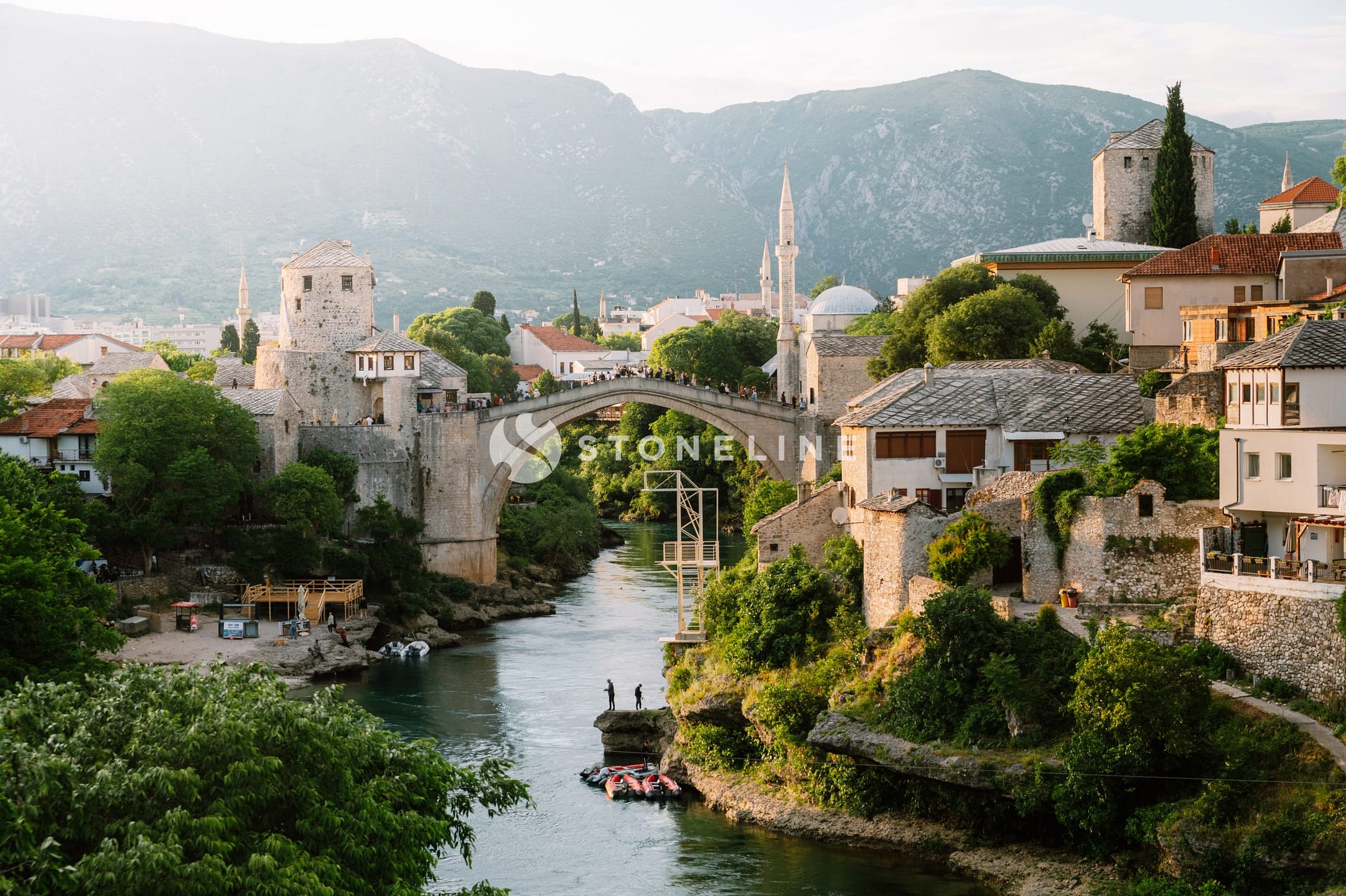
Mostar’s Stari Most is one of the clearest examples in Europe of stone as both structure and symbol. UNESCO describes the Old Bridge area as a place where the rebuilt bridge and the surrounding urban fabric represent a powerful case of post-conflict restoration and the continuation of a shared cultural landscape.
Technically, Stari Most is a masterclass in compressive architecture. The stone arch is not “strong because stone is strong,” but because the geometry routes forces into compression along the curve, while the masonry units (voussoirs) and joints maintain load paths with minimal tensile demand. When such bridges fail, it is often due to localised issues—water infiltration, freeze–thaw damage, settlement, or inappropriate repairs—rather than a simple material weakness.
Material authenticity has been central to Stari Most’s modern history. The bridge was destroyed in 1993 and reopened after reconstruction in 2004, with international involvement and an explicit goal of respecting original techniques and materials as closely as feasible. Research and reconstruction documentation discusses the historic use of local limestone—often referred to as tenelija—and the emphasis on sourcing appropriate stone for the rebuild, aligning physical behaviour with the original fabric.
From a stone-durability standpoint, a bridge like Stari Most has a uniquely harsh exposure profile: wind-driven rain, direct water proximity, thermal cycling, and surface abrasion from constant use. That means “natural stone durability” is not a slogan; it is measurable through characteristics such as pore structure, water absorption, and resistance to salt and frost. But durability is also crafted:
- Jointing and mortar selection: lime-based systems can offer compatibility and vapour permeability that reduce trapped moisture.
- Stone orientation and detailing: bedding planes and exposed edges matter greatly in long-term decay patterns.
- Surface treatments: aggressive sealants can be counterproductive if they trap moisture; breathable approaches are usually preferred in heritage contexts.
For modern projects, Stari Most is a reminder that resilient stone design is a systems problem: quarry selection, block quality, cutting accuracy, joint geometry, water management, and maintenance plans together determine whether a stone structure lasts for centuries—or only looks like it should.
Sources (for this article)
- UNESCO — Old Bridge Area of the Old City of Mostar (World Heritage listing).
- UNESCO — Rebuilding of Stari Most (context and significance).
- Reconstruction technical document (PDF) discussing geometry/material considerations.
- Reference noting local limestone “tenelija” used for Stari Most.
- Archnet — Stari Most listing/context.