Stoneline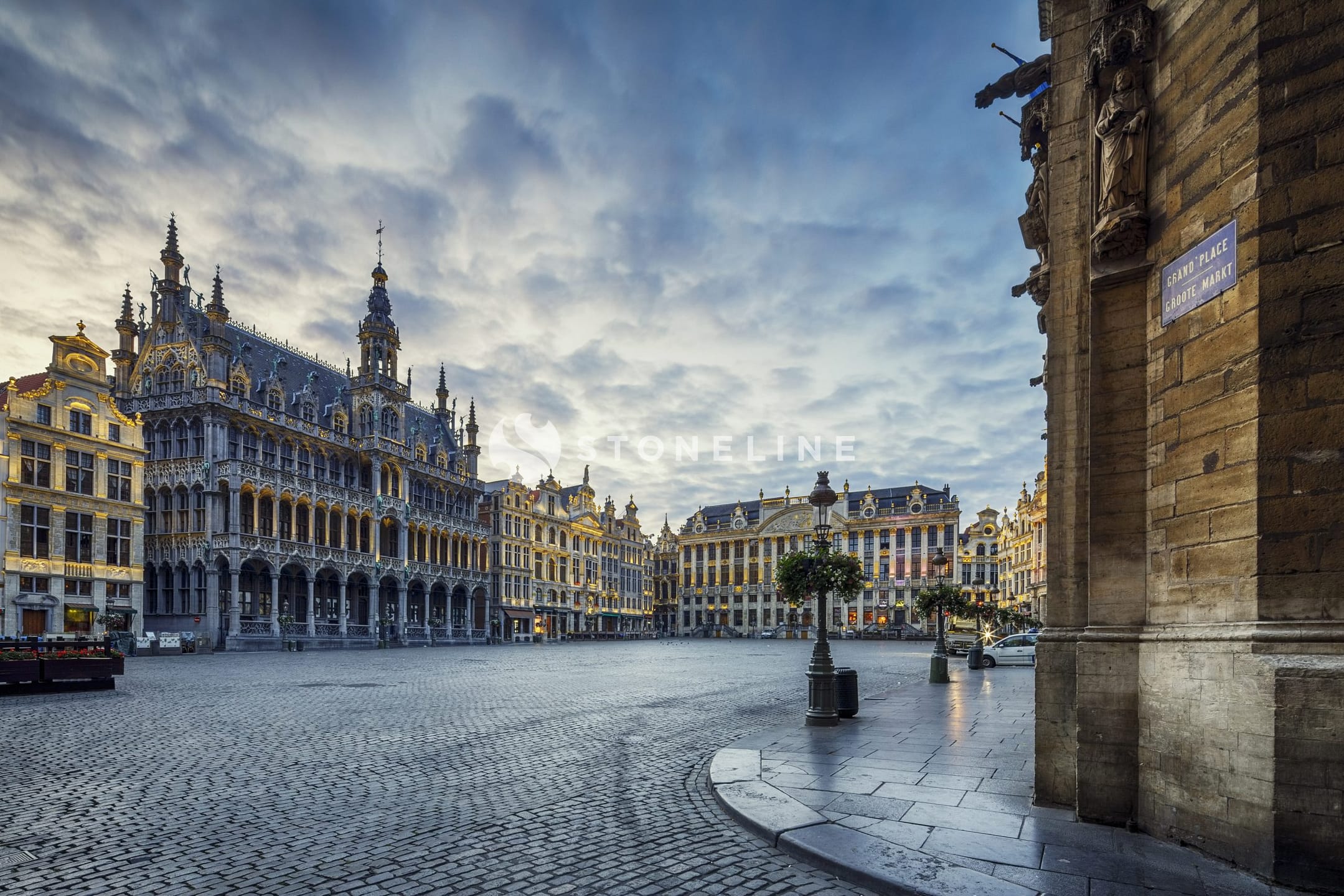
Brussels’ Grand-Place is a concentrated lesson in how stone defines civic memory. UNESCO’s inscription highlights the square as an exceptional example of an architectural and urban ensemble—one shaped by guild houses and public buildings whose façades create a coherent, monumental “room” in the city.
For stone practitioners, the square is compelling for two reasons: vertical stonework (façades, sculptural ornament, architectural details) and horizontal stonework (the ground plane, where cobblestones handle centuries of footfall, cleaning cycles, and seasonal wetting). Even when façades are gilded or painted, their underlying stone logic remains legible: carving depth, joint rhythm, and the way profiles cast shadow are all functions of stone tooling and durability.
The paving is equally instructive. Accounts of Brussels’ cobblestone heritage describe the Grand Place’s surface as part of a broader tradition of Belgian stone pavements—commonly associated with hard stones such as Belgian porphyry in historic streetscapes, and described by local reporting as using Belgian stone materials in and around the centre. In practice, the technical requirements for such pavements are strict: high abrasion resistance, good frost durability, and performance under repeated wetting and de-icing salts. Aesthetic continuity matters, but so do coefficients of friction and the long-term stability of bedding layers.
For heritage restoration, Grand-Place also reinforces a central rule: replace like with like, but document the “like.” Successful interventions typically start with:
- Stone identification: petrographic analysis and comparison of physical properties (open porosity, water absorption, compressive strength, salt resistance).
- Decay mapping: understanding whether damage is driven by rising damp, façade runoff, atmospheric deposition, or biological films.
- Detail replication: maintaining tooling marks, edge arrises, and joint profiles—because these affect how the stone sheds water and how quickly it soiles.
- Procurement discipline: ensuring consistent batches for colour and texture, particularly for bespoke stone projects where a single façade bay can reveal variability.
What makes Grand Place enduring is not only its design but its material governance—the slow, careful work of maintenance, replacement, and craft continuity that keeps a stone ensemble readable across centuries.
Sources (for this article)
- UNESCO — La Grand-Place, Brussels (World Heritage description and significance).
- Brussels Express — “Cobblestone heritage” context (Grand Place cobblestone discussion).
- The Brussels Times — Notes on cobblestone material variety in Brussels, incl. Grand Place.