Stoneline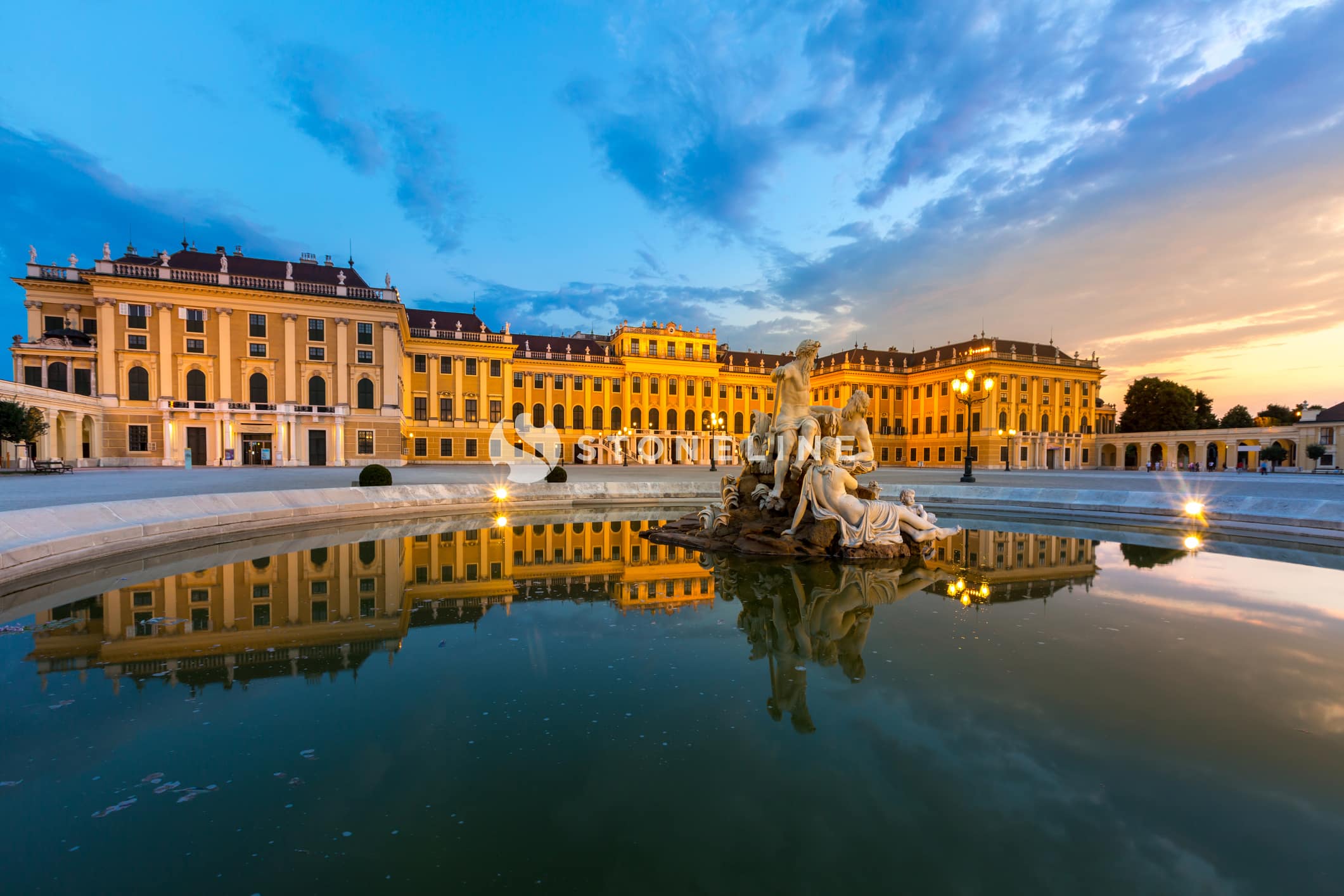
Schönbrunn Palace in Vienna is often described through the lens of Baroque composition axial gardens, orchestrated vistas, and an architectural language designed to communicate imperial permanence. Yet that sense of permanence is not only stylistic; it is also material. The Schönbrunn ensemble is part of a UNESCO World Heritage property, and its long-term legibility depends heavily on the performance of its building stones in an urban atmosphere shaped by moisture, freeze–thaw cycles, pollution, and biological growth.
In the Habsburg context, limestone is not simply “a façade material.” In Austria, many historic quarries supplied biogenic limestones (including the Leitha Limestone family) that were valued for workability, availability in large blocks, and a performance profile that can be engineered—through selection, orientation, finishing, and detailing—toward a target service life. Engineering geology literature notes the importance of these Austrian limestones and points specifically to Kaisersteinbruch quarries as a source of high-quality stone historically used in the region.
For heritage sites like Schönbrunn, the key technical challenge is compatibility: replacement stones must behave like the original under the same exposure regime. Many conservation failures are not dramatic fractures but slow incompatibilities—mismatched porosity, different capillary uptake, or inconsistent salt transport—leading to accelerated scaling and contour loss. Austrian geological documentation on Leithakalk (Leitha limestone) explicitly references its use in Vienna restoration work and cites architectural and sculptural applications at Schönbrunn, underscoring how closely this material family is tied to the city’s historic fabric.
A useful way to read Schönbrunn, therefore, is as a “stone performance laboratory” at a monumental scale. Even within the palace gardens, carbonate stones appear in different roles, from load-bearing and paving contexts to decorative elements. The Neptune Fountain page from Schönbrunn’s official site identifies Sterzing marble for the sculptural group—an instructive contrast, because marble and limestone share carbonate chemistry yet often respond differently to weathering, microcracking, and biological films.
From a specification perspective—especially for UK-facing projects—Schönbrunn reinforces four practical principles:
- Match pore structure before you match colour. Visual similarity without comparable porosity and capillarity is a common route to premature decay.
- Detailing is durability. Drips, throats, and ventilated interfaces can extend service life more than small differences in strength class.
- Finish selection is an engineering choice. Honed, sandblasted, and tooled finishes each change wetting behaviour and soiling patterns.
- Plan maintenance as part of design. For heritage settings, cleaning regimes, water management, and biological control are as important as the initial stone selection.
In short, Schönbrunn’s “timelessness” is not an abstraction. It is the outcome of quarry geology, craft practice, and conservation decisions working together across centuries—exactly the intersection where high-quality natural stone and custom stone designs matter most.
Sources (for this article)
- UNESCO — Schönbrunn Palace World Heritage listing overview.
- Vienna.info — Schönbrunn Palace background (history and significance).
- Schönbrunn official site — Neptune Fountain (Sterzing marble, design notes).
- Bednarik et al., Engineering Geology — Leitha Limestone / Kaisersteinbruch context (historical quarry significance).
- Austrian geological documentation (PDF) referencing Leithakalk applications incl. Schönbrunn architecture/sculpture.