

Posted on Leave a comment

The Grandeur of Natural Stone at Casa Rosada

Casa Rosada with waving flag at sunset

A “pink façade” built on masonry—and finished for permanence

Casa Rosada’s identity is inseparable from its colour. The official Casa Rosada history states that President Sarmiento painted its façade pink, and that the building is a composite of earlier governmental structures developed through the 19th century.
From a materials standpoint, this matters: Casa Rosada is not primarily a stone-clad façade story in the way some European state buildings are. It is a story of masonry substrate and protective finishes designed to handle Buenos Aires’ humidity and the building’s civic visibility.

A modern explanation of the pink finish tradition highlights historic practices of mixing lime with additives (including the widely repeated “cow’s blood” account) to improve water resistance and adhesion—an example of early moisture-management thinking in architectural coatings.

Where marble enters: interiors as institutional symbolism

Even if the exterior reads as colour and stucco, Casa Rosada’s interiors use stone to communicate continuity and authority. The official “Halls & Salons” description notes a Carrara marble bust in the White Hall and mentions bronze elements on marble plaques, placing marble directly inside the building’s ceremonial core.
Technical lens: marble in civic interiors performs beyond aesthetics:

  • it acts as a durable, cleanable surface in high-visibility rooms,
  • it supports fine sculptural detail,
  • it visually stabilises ornate spaces (a “calm” material against complex ornament).

Luxury stone design in an Argentine civic context

In many state buildings of the late-19th-century Atlantic world, the most durable “luxury” materials are concentrated in:

  • primary reception halls,
  • formal staircases and landings,
  • fireplaces, chimneypieces, and sculptural programs.

Casa Rosada’s official interior descriptions align with this pattern through their explicit references to marble artworks and marble-backed features.

Bespoke stone materials: not more stone—better stone placement

Casa Rosada illustrates an advanced principle that modern natural-stone design still benefits from: you don’t need stone everywhere to create permanence. Instead, you place premium stone where it performs best:

  • touch points (thresholds, stair edges, plinths),
  • ceremonial focal points (sculpture, fireplaces, memorial elements),
  • high-cleaning zones where finish stability matters over decades.

This is how “bespoke” should be read: not exoticity for its own sake, but precision—choosing the right stone, finish, and detail for the building’s most meaningful and demanding spaces.

Sources used: Casa Rosada (official history) ; Casa Rosada (official Halls & Salons—Carrara marble references) ; Sacyr note on traditional pink finish explanations .
https://www.casarosada.gob.ar/international/argentine-government-house/historysacyr.com/en/-/los-secretos-de-la-casa-rosada/blog

Posted on Leave a comment

The Timeless Beauty of Stone in Westminster Abbey

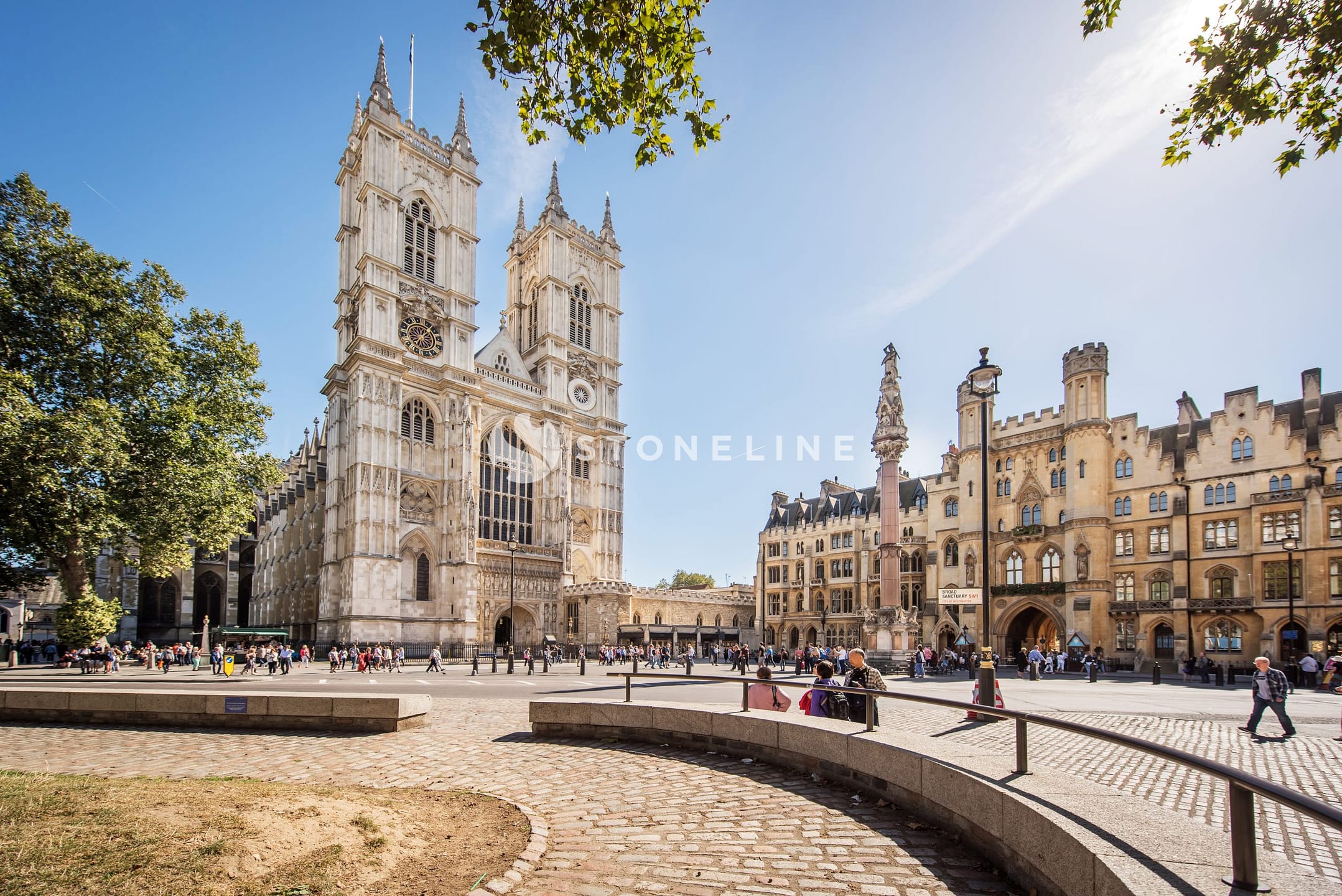
Historic buildings in a sunny public square

A Gothic building written in geology

Westminster Abbey is often described through its kings, coronations, and craftsmanship—but its longevity is equally a story of materials science. The Abbey’s High Gothic design depends on a structural grammar of pointed arches, rib vaults, and flying buttresses; yet the performance of that system over centuries is inseparable from the behaviour of its stones under London’s moisture, pollution, and cyclic weathering. The Abbey itself notes that key medieval stonework came from Caen (France) and Reigate (England), while Purbeck marble was used extensively for columns—an intentional palette that combined workability, aesthetics, and status. Westminster Abbey.

The principal stone palette

Caen limestone: workable detail stone with historic reach

Caen stone (a fine, light-coloured limestone from Normandy) was widely valued in medieval construction because it could be cut and carved with precision—ideal for tracery, mouldings, and figurative work. In the Abbey’s own historical account, Caen is explicitly named among the sources of its principal stonework.


Technical lens: limestones like Caen are typically chosen for their uniform texture and predictable tooling, but their long-term durability depends on porosity, soluble salts, and exposure severity. In sheltered interiors they can remain crisp for centuries; in exposed urban settings they can suffer granular disintegration and scaling.

Reigate stone: the structural reality behind the beauty

Reigate stone—sourced from England—was historically used in major structural and carved elements. Westminster Abbey describes Reigate among the core medieval stones and also acknowledges that decay was caused by weathering of the Reigate sandstone and pollution from coal smoke, a frank recognition that “good” stone is still site-dependent.Westminster Abbey.


A useful geological description of Reigate stone is preserved in building-stone documentation for English ecclesiastical fabric: it is a glauconitic, slightly micaceous sandstone (from the Upper Greensand) and is described as badly weathered in service—an important caution for conservation material matching. Rochester Cathedral

Purbeck marble: polish, symbolism, and interior resilience

The Abbey highlights “the lavish use of polished Purbeck marble for the columns,” an unmistakable signature of English Gothic interiors. Westminster Abbey.
Technical lens: Purbeck “marble” is a limestone that can take a high polish, which made it an architectural instrument: it amplifies light, sharpens verticality, and communicates prestige. Indoors, such polished stones often age better than exposed exterior sandstone in polluted, wet urban climates.

Durability lessons from a building that has been repaired for centuries

Westminster Abbey is explicit that its exterior has been restored and re-faced several times in different stones, and that the most recent major restoration work spanned 1973–1995.
From a specifier’s viewpoint, this is not “failure”—it is normal lifecycle management of a complex stone envelope:

  • Stone selection must match needs. A stone that performs well in sheltered interior zones may not be appropriate for fully exposed elevations.
  • Pollution changes the rules. The Abbey’s mention of coal-smoke pollution is a reminder that atmospheric chemistry can accelerate decay mechanisms in calcareous stones and weaken certain sandstones.
  • Repair stone compatibility is non-negotiable. Mineralogy, pore structure, and moisture transport must be compatible to avoid differential weathering, salt concentration, and edge spalling.

What “high-quality stone” really means in heritage contexts

In heritage stonework, “quality” is not a marketing adjective—it is a measurable alignment between stone fabric and service environment. Westminster Abbey’s stone history points to a practical framework still relevant for premium projects today:

  1. Provenance and petrography: know what the stone is (not only what it looks like).
  2. Need zoning: specify different stones/finishes for different façade microclimates (cornices, plinths, parapets).
  3. Testing and detailing: durability is as much about drip edges, water shedding, and maintenance access as it is about compressive strength.

Sources used: Westminster Abbey (official history/architecture) ; building-stone geology note on Reigate stone .