
Posted on Leave a comment

Natural Quartzite or Engineered Quartz?

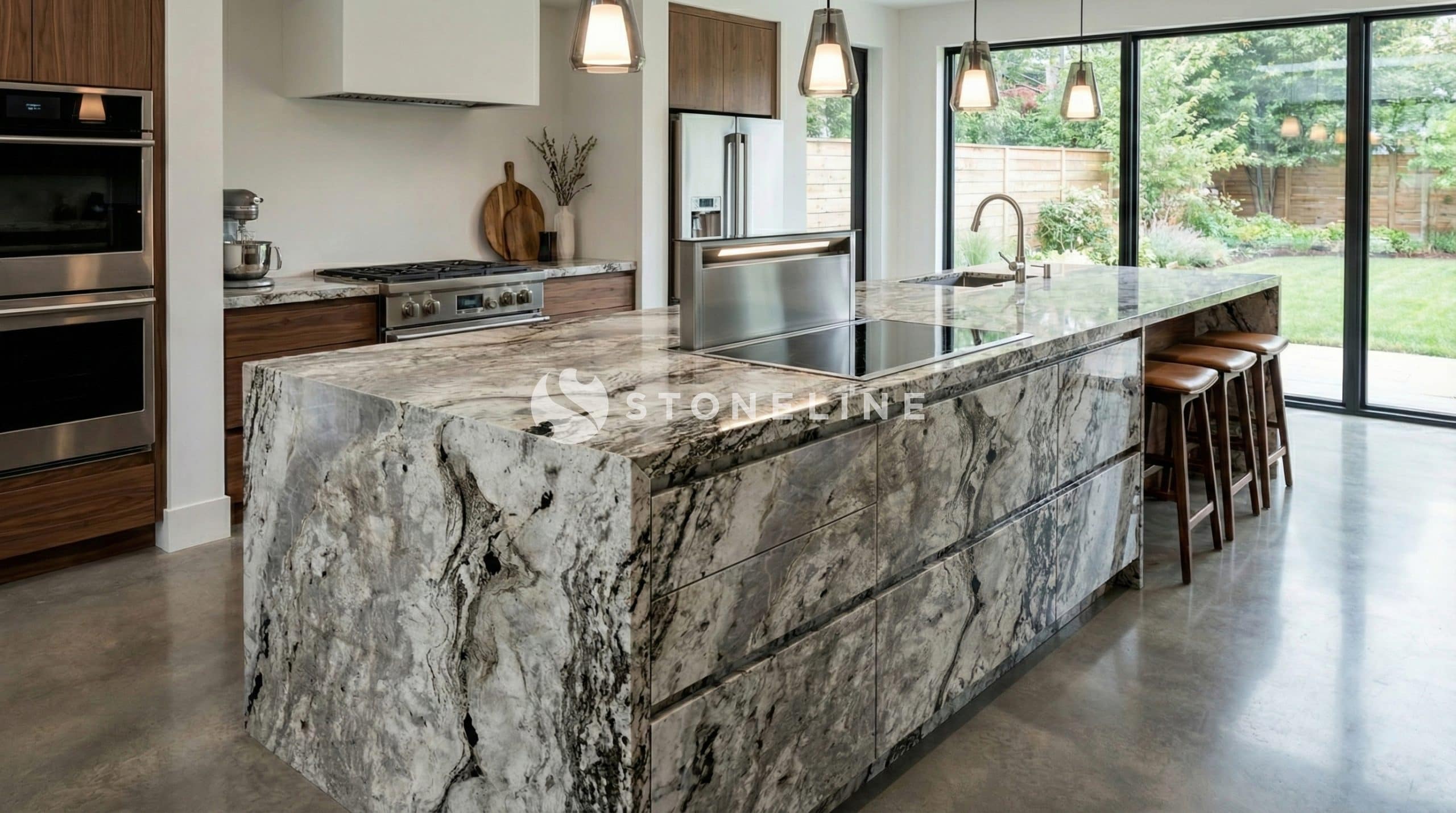
Modern kitchen with large marble waterfall island

A Smart Decision Guide for Kitchen Countertop Selection

Finding Clarity Amid the Confusion

In modern kitchen design, the countertop sits at the very center of both aesthetics and functionality. In recent years, confusion between natural quartzite and engineered quartz has made the decision-making process more challenging for those planning to renovate their kitchens.

At Stoneline, with nearly 30 years of experience in natural stone, our goal is to reduce this confusion and help you make the right long-term choice for your kitchen. In this guide, we examine natural quartzite and engineered quartz from the perspectives of technical performance, aesthetics, and maintenance requirements.

What Is Quartzite?

Nature’s Stone Signature Formed Over Millions of Years

Quartzite (internationally referred to as Quartzite) is a 100% natural metamorphic rock composed primarily of quartz minerals. Its formation process is rooted in natural sand deposits:

  • Origin: Quartz-rich sands found in beaches, deserts, or riverbeds
  • Transformation: These sands compact and cement over time, forming sandstone
  • Metamorphism: Deep within the Earth’s crust, under high heat and pressure, sandstone recrystallizes into quartzite

As a result of this long geological process, a dense, hard, compact natural stone with distinctive veining patterns emerges.

Key Technical Properties of Quartzite

1. High Hardness

Quartzite typically reaches values between 6 and 7 on the Mohs Hardness Scale.
This translates into strong resistance against scratches and everyday wear in kitchen environments.

In practice, using a cutting board is always recommended; however, controlled contact with plates, glasses, and cookware under proper conditions does not easily compromise the stone’s character. This hardness makes quartzite a countertop material that can be used safely for many years.

2. Resistance to Acids

Thanks to its mineral composition, quartzite generally shows good resistance to mild acids commonly used in kitchens, such as lemon juice or vinegar.

When supported by appropriate surface finishes and proper care products, the surface can maintain its uniform appearance for a long time. Compared to more acid-sensitive stones like marble, quartzite stands out as a safer natural stone option for kitchen countertops.

3. Natural Color and Pattern Diversity

Quartzite offers a wide spectrum of colors and veining structures:

  • Color palette: Whites, creams, greys, greens, blues, and warm tonal transitions
  • Veining: Fine marble-like veins, flowing dynamic patterns, crystallized textures
  • Uniqueness: As a natural stone, no two slabs are identical—each slab is one of a kind

These characteristics make quartzite a material that adds strong character to both modern minimalist kitchens and more classic, detailed designs. In premium kitchen projects, this “one-of-a-kind” natural appearance is one of the key values that differentiates quartzite from engineered surfaces.

What Is Engineered Quartz?

A Composite Surface from Controlled Production

Despite its name, engineered quartz is often confused with natural stone, but it is actually a composite material produced in factory environments. Its general composition includes:

  • Approximately 70–90% quartz particles by weight
  • Polymer resins as binders
  • Pigments for color and pattern effects
  • Additional additives when required

During production, quartz particles are mixed with resin, molded, compacted under vibration and pressure, and cured at controlled temperatures. The result is a repeatable, homogeneous, industrial surface. It is not a natural stone.

Advantages and Limitations of Engineered Quartz

Engineered quartz offers certain conveniences, but these same features also introduce limitations when compared to natural stone:

  • Color consistency:
    Slabs within the same series can be produced with nearly identical tones. While this may be practical for large-scale projects, it can appear monotonous and artificial for users who appreciate natural variation. In fact, what is being replicated is the appearance of natural stone itself.
  • Pattern control:
    Veined, speckled, or solid-color surfaces can be designed in a controlled manner. While this offers predictability in design, it falls short of replicating the organic depth and randomness of natural quartzite—especially noticeable in premium applications.
  • Maintenance perception:
    Engineered quartz is often marketed as “low maintenance” or “stain resistant.” However, this narrative tends to downplay its sensitivity to high heat and certain chemicals. Unlike natural stone, engineered surfaces cannot regain their original condition over time through maintenance. What appears practical in theory still requires careful use in real life.

In short, engineered quartz can be considered a practical surface for specific projects; however, when it comes to natural stone feel, long-term material maturity, and unique aesthetics, it cannot replace quartzite.

Quartzite vs. Engineered Quartz: A Comparison

Hardness and Durability

Quartzite:

  • Mohs hardness typically between 6–7
  • High resistance to scratching in daily kitchen use
  • When applied with correct thickness and detailing, it can last as long as the kitchen itself

Engineered Quartz:

  • Contains quartz minerals, offering a degree of surface durability
  • As a composite product, long-term behavior depends on resin performance
  • May show surface dulling and fatigue over time, especially under heavy use

Simply put: quartzite’s fully natural structure offers more predictable and long-term durability, while engineered quartz remains limited by its resin content.

Heat Resistance

Quartzite:

  • Naturally resistant to typical kitchen heat levels
  • As with all natural stones, extreme thermal shock should be avoided
  • Still, its mineral structure offers superior resistance compared to engineered quartz

Engineered Quartz:

  • More sensitive to heat due to polymer resins
  • Hot pots and pans placed directly on the surface can cause discoloration, burn marks, or deformation
  • Especially critical near cooktops and high-heat zones

From Stoneline’s perspective, if heat resistance and longevity matter at the heart of the kitchen, quartzite stands out as the more reliable choice.

Staining and Maintenance

Quartzite:

  • With proper surface finishing and professional sealing, it offers strong stain resistance
  • Daily cleaning should be done with pH-neutral, non-abrasive products
  • Periodic resealing based on usage helps preserve its original appearance
  • This maintenance routine is a rational investment for long-term value

Engineered Quartz:

  • Low porosity provides resistance to some daily stains
  • However, exposure to harsh chemicals, abrasive cleaners, and heat may cause surface dulling and discoloration
  • Despite its “easy-care” reputation, improper use can lead to faster-than-expected wear

Selected Quartzites from the Stoneline Collection

Stoneline’s collection includes many quartzite options commonly used for kitchen countertops, offering both technical performance and natural aesthetics:

  • Atlantis Quartzite: Soft grey and blue transitions for calm, modern kitchens
  • Astarte Quartzite: Pronounced veining for bold visual impact
  • White Palagone Quartzite: Warm undertones and elegant veining, ideal with wood and metal accents
  • Naca Quartzite: Balanced tones suitable for residential and commercial kitchens
  • Azul Macaubas Quartzite: Blue-leaning hues for distinctive, statement designs
  • Nebula Quartzite: Dark background with dynamic veining for strong contrast
  • Rainbow Quartzite: Rich color transitions that turn a single slab into a design feature
  • Red Lava Quartzite: Bold, warm tones for boutique and character-driven projects

What these stones share is their natural origin, uniqueness, and long lifespan—qualities unattainable in engineered surfaces.

Maintenance and Long-Term Performance

Quartzite Care Tips

  • Apply appropriate surface protection after installation
  • Use pH-neutral cleaners for daily maintenance
  • Always use cutting boards
  • Schedule professional inspections and resealing when necessary

Engineered Quartz Care Tips

  • Avoid placing hot cookware directly on the surface
  • Do not use bleach or abrasive cleaning products
  • Follow manufacturer-approved cleaners to prevent surface damage

Making the Right Choice for Your Kitchen Countertop: Why Quartzite?

A kitchen countertop decision should consider not only how it looks today, but how it will age over time.

From the Stoneline perspective:

Quartzite stands out as the primary choice thanks to:

  • Its natural origin
  • High heat and scratch resistance
  • Unique veining and color character
  • Long-term durability with proper care

Engineered quartz, on the other hand, offers:

  • Homogeneous and repeatable aesthetics
  • Practical solutions for specific budget or design constraints

However, for those seeking natural stone authenticity, geological depth, and long-term character, engineered quartz alone does not provide a complete answer.

In conclusion:
If you are looking for a natural, long-lasting investment for the heart of your kitchen, quartzite is the strongest candidate—just as Stoneline recommends. Engineered quartz remains a more industrial alternative, suitable only for limited and specific scenarios.

Posted on Leave a comment

The Stone Heritage of Parliament Buildings

Canadian Parliament Buildings in winter

Climate is the real client

Few civic complexes demonstrate environmental demand like Canada’s Parliamentary precinct. Here, stone is required to survive freeze–thaw cycles, wind-driven precipitation, and decades of maintenance interventions—while preserving Gothic Revival character and carved detail.

Nepean sandstone: local quartz richness and façade identity

A Senate of Canada feature on restoration describes the Centre Block façade as surfaced in sandstone and notes that Nepean sandstone—sourced from a quarry near Ottawa—forms the bulk of the façade and derives durability from its high quartz content.
From a geological perspective, field descriptions of Nepean sandstone commonly describe it as quartz-rich with cross-bedding—features consistent with strong abrasion resistance and generally favourable weathering behaviour when properly detailed.

Why multiple sandstones were used

Heritage stonework is rarely monolithic. A Parks Canada designation note explicitly references construction using Nepean, Ohio and Potsdam sandstone across elements of the Parliamentary complex—an approach that often reflects a rational split between:

  • a tougher facing stone for broad wall planes, and
  • a more easily carved stone for trim, mouldings, and decorative details.

A Carleton geology walking tour document makes the same logic explicit for the West Block: Nepean Sandstone as quartz arenite for the façade, with Ohio Sandstone used where carving and tooling are essential (jambs, lintels, string courses, and ornate details).

Durability evidence: frost resistance and long service life

In a GeoScience Canada paper on Canada’s federal Parliament buildings, Nepean Sandstone is discussed as a primary building stone, with testing commentary indicating it is very durable and little affected by freeze–thaw—exactly the performance threshold demanded by Ottawa winters.
This is the most important technical takeaway for specifiers: “durable” is not a vibe; it is performance under the dominant decay mechanism of the site.

Modern interventions: continuity through compatible replacement and systems

Canada’s own Parliamentary Precinct history notes that later reconstruction used a steel frame “covered with the same Nepean sandstone that was used in the original buildings,” signalling a preservation principle: retain the material identity even when the structural system evolves.

In many heritage contexts, original quarries become unavailable. A conservation/cleaning design paper notes that Nepean sandstone is no longer available and that St. Canut sandstone (Québec) has been used as a replacement stone in recent projects—an example of modern material substitution governed by compatibility rather than perfect sameness.

Outdoor stonework: what the precinct teaches every project

For exterior natural-stone projects in harsh climates, Parliament Hill offers a practical playbook:

  • Use stone diversity intelligently: one stone for massing, another for carving and detail.
  • Design for water shedding: the best stone fails if water is trapped at ledges, joints, and parapets.
  • Plan for lifecycle sourcing: identify compatible “future stones” early to avoid mismatched repairs decades later

Sources used: Senate of Canada restoration feature ; Ottawa–Gatineau Geoheritage (Nepean sandstone description) ; Parks Canada designation ; Carleton geology walking tour PDF ; GeoScience Canada paper (freeze–thaw durability commentary) ; Canada Parliamentary Precinct history ; conservation/design note on replacement stone availability .

https://sencanada.ca/en/sencaplus/how-why/weathered-beauty-restoring-centre-blocks-century-old-facade

https://www.ottawagatineaugeoheritage.ca/subsites/18

https://www.canada.ca/en/public-services-procurement/services/infrastructure-buildings/parliamentary-precinct/history.html

https://www.canadamasonrydesigncentre.com/wp-content/uploads/15th_symposium/062-Edgar.pdf

Posted on Leave a comment

The Grandeur of Natural Stone at Casa Rosada

Casa Rosada with waving flag at sunset

A “pink façade” built on masonry—and finished for permanence

Casa Rosada’s identity is inseparable from its colour. The official Casa Rosada history states that President Sarmiento painted its façade pink, and that the building is a composite of earlier governmental structures developed through the 19th century.
From a materials standpoint, this matters: Casa Rosada is not primarily a stone-clad façade story in the way some European state buildings are. It is a story of masonry substrate and protective finishes designed to handle Buenos Aires’ humidity and the building’s civic visibility.

A modern explanation of the pink finish tradition highlights historic practices of mixing lime with additives (including the widely repeated “cow’s blood” account) to improve water resistance and adhesion—an example of early moisture-management thinking in architectural coatings.

Where marble enters: interiors as institutional symbolism

Even if the exterior reads as colour and stucco, Casa Rosada’s interiors use stone to communicate continuity and authority. The official “Halls & Salons” description notes a Carrara marble bust in the White Hall and mentions bronze elements on marble plaques, placing marble directly inside the building’s ceremonial core.
Technical lens: marble in civic interiors performs beyond aesthetics:

  • it acts as a durable, cleanable surface in high-visibility rooms,
  • it supports fine sculptural detail,
  • it visually stabilises ornate spaces (a “calm” material against complex ornament).

Luxury stone design in an Argentine civic context

In many state buildings of the late-19th-century Atlantic world, the most durable “luxury” materials are concentrated in:

  • primary reception halls,
  • formal staircases and landings,
  • fireplaces, chimneypieces, and sculptural programs.

Casa Rosada’s official interior descriptions align with this pattern through their explicit references to marble artworks and marble-backed features.

Bespoke stone materials: not more stone—better stone placement

Casa Rosada illustrates an advanced principle that modern natural-stone design still benefits from: you don’t need stone everywhere to create permanence. Instead, you place premium stone where it performs best:

  • touch points (thresholds, stair edges, plinths),
  • ceremonial focal points (sculpture, fireplaces, memorial elements),
  • high-cleaning zones where finish stability matters over decades.

This is how “bespoke” should be read: not exoticity for its own sake, but precision—choosing the right stone, finish, and detail for the building’s most meaningful and demanding spaces.

Sources used: Casa Rosada (official history) ; Casa Rosada (official Halls & Salons—Carrara marble references) ; Sacyr note on traditional pink finish explanations .

https://www.casarosada.gob.ar/international/argentine-government-house/historysacyr.com/en/-/los-secretos-de-la-casa-rosada/blog

Posted on Leave a comment

Marble Elegance at the Winter Palace in Saint Petersburg

Illuminated historic building with reflection in water.

Luxury architecture as a choreography of surfaces

The Winter Palace is not just a building; it is an interior landscape where stone is used to control light, ceremony, and permanence. In Saint Petersburg’s severe climate, the cultural ambition of imperial architecture required materials that could carry symbolic weight while tolerating continuous occupation, heating cycles, and large crowds.

St George’s Hall: stone as imperial theatre

One of the clearest examples of stone’s role is St George’s Hall, historically the palace’s principal throne room. The State Hermitage Museum’s historical account describes the hall’s monumental scale (about 800 m²) and emphasises its stone language—double Corinthian pink marble columns and a carefully staged interplay of white and colour. Hermitage Museum
Technical lens: large ceremonial interiors depend on stone for:

  • dimensional stability (compared with many timber finishes),
  • surface reflectance (polished marble amplifies light),
  • wear resistance under intense foot traffic.

Fire, rebuilding, and material continuity

The Winter Palace’s history includes catastrophic fire and reconstruction. Encyclopaedia Britannica notes the 1837 fire and that the Winter Palace was recreated in 1839 largely according to the original architectural conception—an early example of restoring not only form, but also the material “idea” of the place.  Encyclopaedia Britannica
For stone specification, this is instructive: after major damage, the goal is rarely to “replace like for like” blindly; it is to restore function + appearance + long-term serviceability, which often demands careful sourcing, finishing, and detailing.

Marble and granite in the Russian architectural imagination

Even when specific rooms vary, the broader St Petersburg context is consistent: marble is frequently deployed for columns, pilasters, staircases, and sculptural settings, while granite is associated with urban monumentality (embankments, plinths, thresholds). The Hermitage’s own discussion of St George’s Hall makes the marble role explicit at the level of architectural order and ceremonial effect. Hermitage Museum

What “custom stone solutions” mean in palatial interiors

In spaces like the Winter Palace, stone is rarely “standard product.” It is a custom system where performance depends on:

  • Selecting blocks for veining logic across columns and wall planes (visual continuity is engineered).
  • Finish engineering (polish vs. honed vs. fine-tooled) to manage glare, abrasion, and maintenance.
  • Anchorage and tolerance for large-format stone under temperature fluctuations.

This is a useful mindset for premium natural-stone projects today: true luxury is controlled variability—celebrating natural pattern while meeting strict architectural constraints.Sources used: State Hermitage Museum (history of St George’s Hall) ; Encyclopaedia Britannica (Winter Palace fire/recreation timeline) .

Posted on Leave a comment

The Timeless Beauty of Stone in Westminster Abbey

Historic buildings in a sunny public square

A Gothic building written in geology

Westminster Abbey is often described through its kings, coronations, and craftsmanship—but its longevity is equally a story of materials science. The Abbey’s High Gothic design depends on a structural grammar of pointed arches, rib vaults, and flying buttresses; yet the performance of that system over centuries is inseparable from the behaviour of its stones under London’s moisture, pollution, and cyclic weathering. The Abbey itself notes that key medieval stonework came from Caen (France) and Reigate (England), while Purbeck marble was used extensively for columns—an intentional palette that combined workability, aesthetics, and status. Westminster Abbey.

The principal stone palette

Caen limestone: workable detail stone with historic reach

Caen stone (a fine, light-coloured limestone from Normandy) was widely valued in medieval construction because it could be cut and carved with precision—ideal for tracery, mouldings, and figurative work. In the Abbey’s own historical account, Caen is explicitly named among the sources of its principal stonework.


Technical lens: limestones like Caen are typically chosen for their uniform texture and predictable tooling, but their long-term durability depends on porosity, soluble salts, and exposure severity. In sheltered interiors they can remain crisp for centuries; in exposed urban settings they can suffer granular disintegration and scaling.

Reigate stone: the structural reality behind the beauty

Reigate stone—sourced from England—was historically used in major structural and carved elements. Westminster Abbey describes Reigate among the core medieval stones and also acknowledges that decay was caused by weathering of the Reigate sandstone and pollution from coal smoke, a frank recognition that “good” stone is still site-dependent.Westminster Abbey.


A useful geological description of Reigate stone is preserved in building-stone documentation for English ecclesiastical fabric: it is a glauconitic, slightly micaceous sandstone (from the Upper Greensand) and is described as badly weathered in service—an important caution for conservation material matching. Rochester Cathedral

Purbeck marble: polish, symbolism, and interior resilience

The Abbey highlights “the lavish use of polished Purbeck marble for the columns,” an unmistakable signature of English Gothic interiors. Westminster Abbey.
Technical lens: Purbeck “marble” is a limestone that can take a high polish, which made it an architectural instrument: it amplifies light, sharpens verticality, and communicates prestige. Indoors, such polished stones often age better than exposed exterior sandstone in polluted, wet urban climates.

Durability lessons from a building that has been repaired for centuries

Westminster Abbey is explicit that its exterior has been restored and re-faced several times in different stones, and that the most recent major restoration work spanned 1973–1995.
From a specifier’s viewpoint, this is not “failure”—it is normal lifecycle management of a complex stone envelope:

  • Stone selection must match needs. A stone that performs well in sheltered interior zones may not be appropriate for fully exposed elevations.
  • Pollution changes the rules. The Abbey’s mention of coal-smoke pollution is a reminder that atmospheric chemistry can accelerate decay mechanisms in calcareous stones and weaken certain sandstones.
  • Repair stone compatibility is non-negotiable. Mineralogy, pore structure, and moisture transport must be compatible to avoid differential weathering, salt concentration, and edge spalling.

What “high-quality stone” really means in heritage contexts

In heritage stonework, “quality” is not a marketing adjective—it is a measurable alignment between stone fabric and service environment. Westminster Abbey’s stone history points to a practical framework still relevant for premium projects today:

  1. Provenance and petrography: know what the stone is (not only what it looks like).
  2. Need zoning: specify different stones/finishes for different façade microclimates (cornices, plinths, parapets).
  3. Testing and detailing: durability is as much about drip edges, water shedding, and maintenance access as it is about compressive strength.

Sources used: Westminster Abbey (official history/architecture) ; building-stone geology note on Reigate stone .

Posted on Leave a comment

Stoneline Celebrated The 20th Anniversary With Fazıl Say Concert

On the occasion of the 20th Anniversary, Stoneline celebrated her 20th anniversary with her friends in the sector, which was a wonderful concert given by the world-famous pianist Fazıl Say at Zorlu PSM on Thursday, May 25th.

Stoneline is one of the leading companies in the industry that imports and exports marble, granite, travertine, onyx and semi-precious stones, which are indispensable elements of the architecture. Stoneline makes it possible, a natural and innovative atmosphere by bringing together the living spaces and natural stones which are resembling like paintings with unique textures and many varieties. Stoneline provides designing, project planning, manufacturing, installation, surface protection and after-sales services. In January 2016, the leader of the world’s natural stone industry Antolini Italy and Stoneline agreed on an exclusive partnership in Turkey. Finally, we are pleased to ensure the accessibility of the most special and the rarest natural Stones in the World…