Stoneline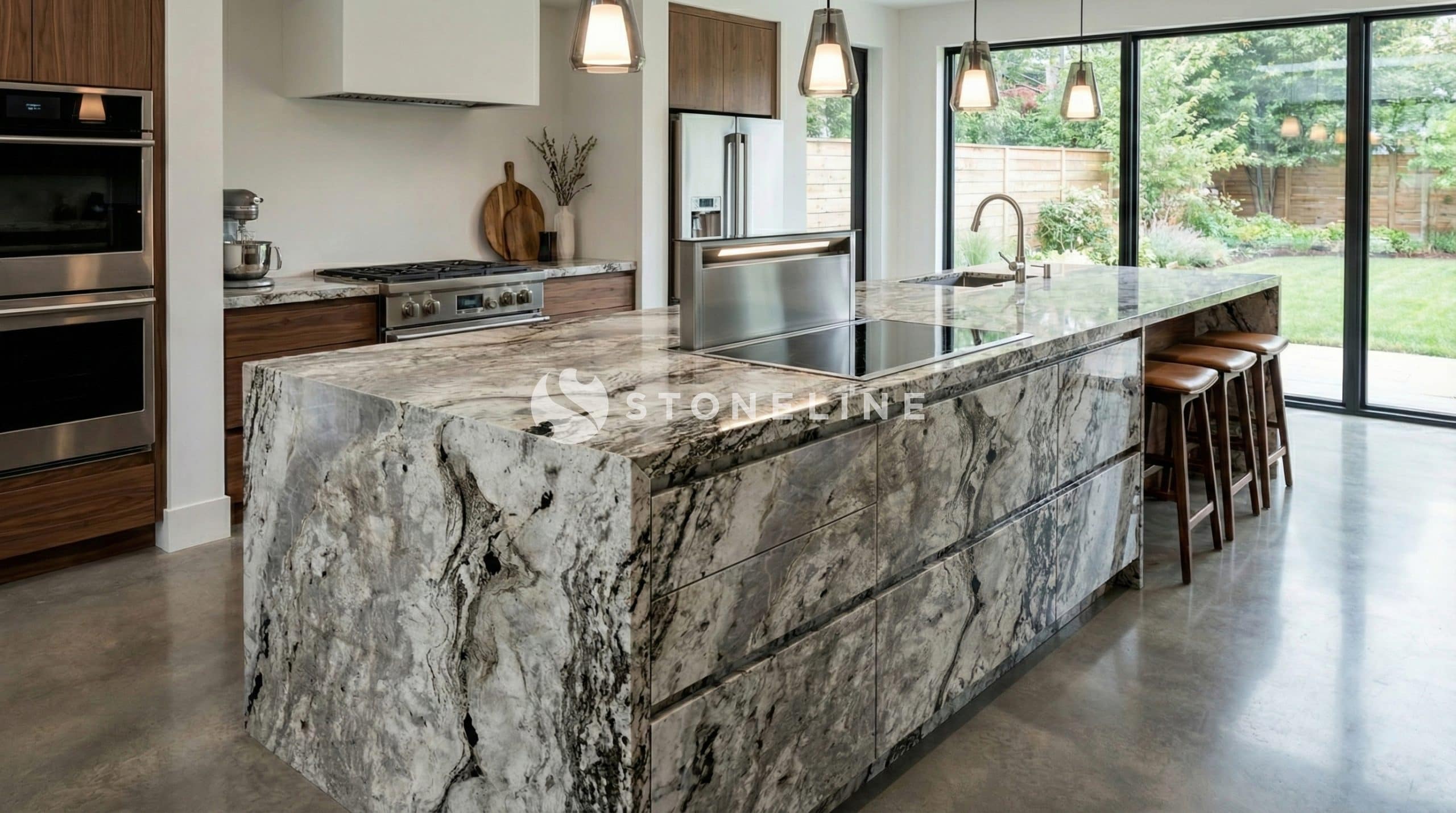
A Smart Decision Guide for Kitchen Countertop Selection
Finding Clarity Amid the Confusion
In modern kitchen design, the countertop sits at the very center of both aesthetics and functionality. In recent years, confusion between natural quartzite and engineered quartz has made the decision-making process more challenging for those planning to renovate their kitchens.
At Stoneline, with nearly 30 years of experience in natural stone, our goal is to reduce this confusion and help you make the right long-term choice for your kitchen. In this guide, we examine natural quartzite and engineered quartz from the perspectives of technical performance, aesthetics, and maintenance requirements.
What Is Quartzite?
Nature’s Stone Signature Formed Over Millions of Years
Quartzite (internationally referred to as Quartzite) is a 100% natural metamorphic rock composed primarily of quartz minerals. Its formation process is rooted in natural sand deposits:
- Origin: Quartz-rich sands found in beaches, deserts, or riverbeds
- Transformation: These sands compact and cement over time, forming sandstone
- Metamorphism: Deep within the Earth’s crust, under high heat and pressure, sandstone recrystallizes into quartzite
As a result of this long geological process, a dense, hard, compact natural stone with distinctive veining patterns emerges.
Key Technical Properties of Quartzite
1. High Hardness
Quartzite typically reaches values between 6 and 7 on the Mohs Hardness Scale.
This translates into strong resistance against scratches and everyday wear in kitchen environments.
In practice, using a cutting board is always recommended; however, controlled contact with plates, glasses, and cookware under proper conditions does not easily compromise the stone’s character. This hardness makes quartzite a countertop material that can be used safely for many years.
2. Resistance to Acids
Thanks to its mineral composition, quartzite generally shows good resistance to mild acids commonly used in kitchens, such as lemon juice or vinegar.
When supported by appropriate surface finishes and proper care products, the surface can maintain its uniform appearance for a long time. Compared to more acid-sensitive stones like marble, quartzite stands out as a safer natural stone option for kitchen countertops.
3. Natural Color and Pattern Diversity
Quartzite offers a wide spectrum of colors and veining structures:
- Color palette: Whites, creams, greys, greens, blues, and warm tonal transitions
- Veining: Fine marble-like veins, flowing dynamic patterns, crystallized textures
- Uniqueness: As a natural stone, no two slabs are identical—each slab is one of a kind
These characteristics make quartzite a material that adds strong character to both modern minimalist kitchens and more classic, detailed designs. In premium kitchen projects, this “one-of-a-kind” natural appearance is one of the key values that differentiates quartzite from engineered surfaces.
What Is Engineered Quartz?
A Composite Surface from Controlled Production
Despite its name, engineered quartz is often confused with natural stone, but it is actually a composite material produced in factory environments. Its general composition includes:
- Approximately 70–90% quartz particles by weight
- Polymer resins as binders
- Pigments for color and pattern effects
- Additional additives when required
During production, quartz particles are mixed with resin, molded, compacted under vibration and pressure, and cured at controlled temperatures. The result is a repeatable, homogeneous, industrial surface. It is not a natural stone.
Advantages and Limitations of Engineered Quartz
Engineered quartz offers certain conveniences, but these same features also introduce limitations when compared to natural stone:
- Color consistency:
Slabs within the same series can be produced with nearly identical tones. While this may be practical for large-scale projects, it can appear monotonous and artificial for users who appreciate natural variation. In fact, what is being replicated is the appearance of natural stone itself. - Pattern control:
Veined, speckled, or solid-color surfaces can be designed in a controlled manner. While this offers predictability in design, it falls short of replicating the organic depth and randomness of natural quartzite—especially noticeable in premium applications. - Maintenance perception:
Engineered quartz is often marketed as “low maintenance” or “stain resistant.” However, this narrative tends to downplay its sensitivity to high heat and certain chemicals. Unlike natural stone, engineered surfaces cannot regain their original condition over time through maintenance. What appears practical in theory still requires careful use in real life.
In short, engineered quartz can be considered a practical surface for specific projects; however, when it comes to natural stone feel, long-term material maturity, and unique aesthetics, it cannot replace quartzite.
Quartzite vs. Engineered Quartz: A Comparison
Hardness and Durability
Quartzite:
- Mohs hardness typically between 6–7
- High resistance to scratching in daily kitchen use
- When applied with correct thickness and detailing, it can last as long as the kitchen itself
Engineered Quartz:
- Contains quartz minerals, offering a degree of surface durability
- As a composite product, long-term behavior depends on resin performance
- May show surface dulling and fatigue over time, especially under heavy use
Simply put: quartzite’s fully natural structure offers more predictable and long-term durability, while engineered quartz remains limited by its resin content.
Heat Resistance
Quartzite:
- Naturally resistant to typical kitchen heat levels
- As with all natural stones, extreme thermal shock should be avoided
- Still, its mineral structure offers superior resistance compared to engineered quartz
Engineered Quartz:
- More sensitive to heat due to polymer resins
- Hot pots and pans placed directly on the surface can cause discoloration, burn marks, or deformation
- Especially critical near cooktops and high-heat zones
From Stoneline’s perspective, if heat resistance and longevity matter at the heart of the kitchen, quartzite stands out as the more reliable choice.
Staining and Maintenance
Quartzite:
- With proper surface finishing and professional sealing, it offers strong stain resistance
- Daily cleaning should be done with pH-neutral, non-abrasive products
- Periodic resealing based on usage helps preserve its original appearance
- This maintenance routine is a rational investment for long-term value
Engineered Quartz:
- Low porosity provides resistance to some daily stains
- However, exposure to harsh chemicals, abrasive cleaners, and heat may cause surface dulling and discoloration
- Despite its “easy-care” reputation, improper use can lead to faster-than-expected wear
Selected Quartzites from the Stoneline Collection
Stoneline’s collection includes many quartzite options commonly used for kitchen countertops, offering both technical performance and natural aesthetics:
- Atlantis Quartzite: Soft grey and blue transitions for calm, modern kitchens
- Astarte Quartzite: Pronounced veining for bold visual impact
- White Palagone Quartzite: Warm undertones and elegant veining, ideal with wood and metal accents
- Naca Quartzite: Balanced tones suitable for residential and commercial kitchens
- Azul Macaubas Quartzite: Blue-leaning hues for distinctive, statement designs
- Nebula Quartzite: Dark background with dynamic veining for strong contrast
- Rainbow Quartzite: Rich color transitions that turn a single slab into a design feature
- Red Lava Quartzite: Bold, warm tones for boutique and character-driven projects
What these stones share is their natural origin, uniqueness, and long lifespan—qualities unattainable in engineered surfaces.
Maintenance and Long-Term Performance
Quartzite Care Tips
- Apply appropriate surface protection after installation
- Use pH-neutral cleaners for daily maintenance
- Always use cutting boards
- Schedule professional inspections and resealing when necessary
Engineered Quartz Care Tips
- Avoid placing hot cookware directly on the surface
- Do not use bleach or abrasive cleaning products
- Follow manufacturer-approved cleaners to prevent surface damage
Making the Right Choice for Your Kitchen Countertop: Why Quartzite?
A kitchen countertop decision should consider not only how it looks today, but how it will age over time.
From the Stoneline perspective:
Quartzite stands out as the primary choice thanks to:
- Its natural origin
- High heat and scratch resistance
- Unique veining and color character
- Long-term durability with proper care
Engineered quartz, on the other hand, offers:
- Homogeneous and repeatable aesthetics
- Practical solutions for specific budget or design constraints
However, for those seeking natural stone authenticity, geological depth, and long-term character, engineered quartz alone does not provide a complete answer.
In conclusion:
If you are looking for a natural, long-lasting investment for the heart of your kitchen, quartzite is the strongest candidate—just as Stoneline recommends. Engineered quartz remains a more industrial alternative, suitable only for limited and specific scenarios.